Labels

Showing posts with label Winter Term. Show all posts

Thursday, March 17, 2016

The Absolutely True Diary of a Part-Time Indian

In the last unit of my Humanities class Forbidden Books at GCE, we learned a lot about diversity. Our studies were mainly focused on a book we chose from a pre-selected variety. My choice of reading was The Absolutely True Diary of a Part-Time Indian by Sherman Alexie. For our Action Project, we we’re asked to compose an essay based on 1 of 4 provided prompts. I chose the prompt that involved interpreting dangerous/controversial text literally, ethically, and symbolically. My biggest struggle of this project was creating a thesis that connected my interpretations and overall idea of the book. I tried my best to overcome this by exploring multiple theses and choosing the one I thought fit best.
LS. Sherman Alexie. (2016)


Have you ever read a part of a novel that made you put it down in shock from explicit language and ideas? While reading Sherman Alexie’s book The Absolutely True Diary of a Part-Time Indian, this happened to me more than just once. Set on an Indian reservation in Wellpinit, Washington, this book follows the life of 14 year old Arnold Spirit and his transition into a predominantly white school. Arnold never quite fit in at his reservation. However, once he changed schools, “not quite fitting in” seemed like a clear understatement. As we follow Arnold through his journey, we can clearly see the change in not only himself, but of the people and places around him. This may seem like a completely innocent retelling of a child's story. But, this book has in fact been banned in multiple parts of the country. My views  of some controversial parts will be in the form of sections divided into literal, ethical, and symbolic interpretations. While I don’t believe the banning was completely justified, in certain situations, Alexie’s portrayal of teens and their behavior can get too stereotypical and explicit.


The primary focus of this particular part of the novel is race and how teens create jokes around the subject. It also touches on how they use explicit language to make the joke more humorous and how when a teen gets offended, they use violence and rash actions.

“Hey, Chief” Roger said. “You want to hear a joke?” “Sure,” I said. “Did you know that Indians are living proof that niggers fuck buffalo?” I felt like Roger had kicked me in the face. That was the most racist thing I’d ever heard in my life. Roger and his friends were laughing like crazy. I hated them. And I knew I had to do something big. I couldn’t let them get away with that shit. I wasn’t just defending myself. I was defending Indians, black people, and buffalo. So I punched Roger in the face (64-65).

In this passage, Roger tells Arnold a racist joke that offends him so he responds with a violent action. On an ethical level, Arnold sees the joke as not only an attack on himself, but as one on multiple cultural backgrounds and species. He feels the need to act to defend those being attacked and responds with the only way he sees fit: violence. Finally, symbolically the text means that this is a very good way to represent Arnold’s struggle throughout the book. There are multiple instances where he is feeling attacked and I felt this did one of the best jobs at providing a blunt and quick response that reflected on his feelings. While I understand Alexie’s message it seems his wording here is unrealistic from my experience as a teen.


The next quote from the book is about is teen relationships. Since this specific relationship was verbally mended by humor, I believe this is a good example of how Alexie wanted to portray teen communication. “‘I love that tree,’ I said. ‘That’s because you’re a tree fag,’ Rowdy said. ‘I’m not a tree fag,’ I said. ‘Then how come you like to stick your dick inside knotholes?’ ‘I stick my dick in the girl trees,’ I said. Rowdy laughed his ha-ha, hee-hee avalanche laugh” (Alexie 255). In the text, the two boys are joking about how Arnold is “in love” with a tree and because of that he places himself inside the tree. Arnold then says he only does that to girl trees to counter the fact that Rowdy called him a “fag”. In an ethical way, this could be seen as just teenage boys being normal and joking around about sexual things. In another, it could be interpreted as Rowdy and Arnold having a negative view on homosexuals because of their word choice and how Arnold doesn't want to be associated with that word. I feel this moment is symbolic for the relationship of Rowdy and Arnold towards the end of the book. Even though they we’re against each other, they can still come back together and joke around. Lastly, this explicit part of the book addresses a adult lesson in a way “changed for teens”. I feel this is one one the best ways to represent how Alexie feels that teens react to certain situations.

“Okay, so it’s like each of these books is a mystery. Every book is a mystery. And if you read all the books ever written, it’s like you’ve read one giant mystery. And no matter how much you learn, you just keep on learning there is so much more you need to learn.” “Yes, yes, yes, yes,” Gordy said. “Now doesn’t that give you a boner?” “I am rock hard,” I said. Gordy blushed. “Well, I don’t mean boner in the sexual sense,” Gordy said. “I don’t think you should run through life with a real erect penis. But you should approach each book— you should approach life— with the real possibility that you might get a metaphorical boner at any point.” “A metaphorical boner” I shouted.”What the heck is a metaphorical boner?” Gordy laughed. “When I say boner, I really mean joy,” he said. “Then why didn’t you say joy? You didn’t have to say boner. Whenever I think about boners, I get confused.” “Boner is funnier. And more joyful” (97-98).

Gordy and Arnold are talking about books and an important idea while then transitioning into an explicit comparison that turns into a conversation about how a sexual term and the word joy are related. In an ethical way, the boys are having a meaningful conversation about books and mysteries. To make this comedic and relatable, Gordy uses a sexual term for the reason of giving Arnold a better understanding of what he is talking about. I believe that this moment is symbolic for how the author believed the character and teens in the modern day deal with situations that don’t make sense to them or are hard to describe. It seems to he like he is inferring that teens use sexual language to both make light and sense of certain things.


The effect of many of these explicit passages through the book was many calls from around the country for the book to be banned. Parents in multiple states gathered and expressed their desires for the book to be removed from their community schools curriculum. In one particular case in Idaho, a local said that the book exposed students to words that they "we do not speak in our home". A student responded with a petition with over 350 signatures saying “our education is being censored”.


While it is usually easy to see Alexie’s purpose in expressing certain ideas, in my experience of being a person in the described age group, I don’t think the wording is realistic enough and seems stereotypical. I do not believe that this warrants the book to be banned. There is plenty of very positive things that can be taken away from this story. However, I feel Alexie would have had a much easier time getting this idea across to the people that want his book banned if he hadn’t hidden it behind a maze of explicit wording.


Works Cited


Alexie, Sherman. The Absolutely True Diary of a Part-time Indian. New York: Little, Brown,
2007. Print.


Flood, Alison. "Sherman Alexie Young-adult Book Banned in Idaho Schools." The Guardian.
Guardian News and Media, 08 Apr. 2014. Web. 17 Mar. 2016.

Wednesday, March 16, 2016

The 2009 Swine Flu Pandemic


In the last unit of my STEAM class Disease at GCE, we learned about the trend of how certain diseases spread. A large part of this unit was learning about how the R-naught of a disease tells how contagious or dangerous a disease could be. For our Action Project, we made a newspaper article about a contagious disease of our choice. My choice of the swine flu was made largely because of a personal encounter I had with it in the past. One part of this project that challenged me was wrapping my head around the use of the Gapminder software. I was easily able to overcome this by better exploring the tools and information it has to offer.
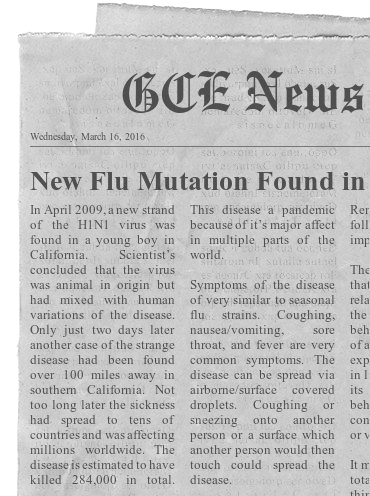
Article. LS. 2016


New Flu Mutation Found in California, Sweeps the World


In April 2009, a new strand of the H1N1 virus was found in a young boy in California. Scientist’s concluded that the virus was had originally developed among animals but had mixed with human variations of the disease. Only two days later another case of the strange disease had been found over 100 miles away in southern California. Not too long later the sickness had spread to tens of countries and was affecting millions worldwide. The disease is estimated to have killed 284,000 in total since the pandemic's beginning in 2009. This disease is a pandemic because of it’s major affect in multiple parts of the world.


H1N1 by Confirmed Community Outbreaks. Menegaz, Felipe. 2009
Symptoms of the disease of very similar to seasonal flu strains. Coughing, nausea/vomiting, sore throat, and fever are very common symptoms. The disease can be spread via airborne droplets or germ covered surfaces. Coughing or sneezing onto another person or a surface which another person would then touch could spread the disease.

The R-naught (R-0) for a disease tells how fast a disease will spread/reproduce on average in a population. From my research I found that the R-0 of Swine flu is around 1.6. Since it's higher than 1, we can expect the disease to spread and thrive in a population. Without a vaccine, the disease will grow as long as there are new people to infect make it's way through a large amount of people.

One major factor for the spread of the disease is transportation. Since global transportation has drastically evolved, any person with any disease can be on the direct other part of the world in under 24 hours. Because of this, the swine flu virus was able to be transported to many different locations before people were even able to recognize the fact that it was a new and dangerous form of the flu.

Another large risk factor of swine flu is having young and elderly people that are more susceptible to catching it. We can use the Gapminder software to illustrate how this factor makes certain countries have a higher chance of having more people contract swine flu in modern day. According to the most recent data on the site, Uganda and the Congo Democratic Republic are the countries that are the most at risk. This is because they are the two countries with the highest amount of children and elderly per 100 adults. The disease could spread better through a population with more people at a higher risk.

LS. Children & Elderly vs Cars, Trucks, and Busses. 2016

The length of the pandemic was not too long as it only lasted until 2010. By April, it was determined that the swine flu was no longer a pandemic. The decline of the pandemic can be attributed to the development of a vaccine. With its development towards the end of the pandemic, the amount of cases started to slow to reasonable numbers. In current day, this particular strand of H1N1 is equivalent to the seasonal flu.

The best way to prevent any swine flu outbreak in the future is to get people protected. Getting the vaccine is the best possible way to protect yourself from contracting H1N1. Other day-to-day things you can do is actively washing your hands and avoiding touching your face as much as possible. Publicly advocating the importance of a flu shot in all countries across the world and making sure the price of one is as low as possible can keep another epidemic from occurring.


Works Cited

"The 2009 H1N1 Pandemic: Summary Highlights, April 2009-April 2010." Centers for Disease Control and Prevention. Centers for Disease Control and Prevention, 16 June 2010. Web. 16 Mar. 2016.
"The International Response to the Influenza Pandemic: WHO Responds to the Critics." World Health Organization. World Health Organization, n.d. Web. 16 Mar. 2016.
"The Newspaper Clipping Generator." The Newspaper Clipping Generator - Create Your Own Fun Newspaper. N.p., n.d. Web. 16 Mar. 2016.
Ross, Robert. "CDC Estimate of Global H1N1 Pandemic Deaths: 284,000." Center for Infectious Disease Research and Policy. Regents of the University of Minnesota, 27 June 2012. Web. 16 Mar. 2016.
"Swine Flu (H1N1)." Healthline. Healthline Media, 14 Dec. 2015. Web. 16 Mar. 2016.

Sunday, March 6, 2016

World War II Censorship

For the second unit of my humanities class Forbidden books at GCE, we studied what it means for a society to have dogma. Another major part of this unit was creating different interpretations about different pieces of text.  For our Action Project, we were given the choice to select any time period that showed censorship and study it. After we gathered research, we made a slideshow that represented all our information. The hardest part of this project was perfecting the citations. How I overcame this was using online resources like easy-bib.


Thursday, February 25, 2016

Anorexia Nervousa

For Unit 2 in the Winter term of my Disease class at GCE, we investigated mental illnesses. The main disease we studied was Autism. However we also looked very in depth at schizophrenia. For our Action Project, we had to choose a disease, create a lesson plan and a simulation to give people an experience a disease, and make a fact sheet. The best part of this AP in my opinion was the simulation. It was the most engaging and fun part of this project. The hardest part in my opinion was setting up the simulation. My disease, Anorexia Nervosa, was tricky to simulate without offending anyone. To overcome this, I just made sure I asked everyone if they wanted to participate and was careful bout what I said.

GM. Lucas Presenting. (2016)

For my project, I did Anorexia Nervosa. I will provide both a personal and dictionary definition for the disease as a basis for what is is. Here is my personal definition: An eating disorder which causes the person to have an unusually large fear of weight gain. Because of this, the person feels the need to abscess about calories/exercise and intentionally lose an unhealthy amount of weight.

In the DSM-V, this is the criteria for Anorexia Nervosa:

“A. Restriction of energy intake relative to requirements, leading to a significantly low body weight in the context of age, sex, developmental trajectory, and physical health. Significantly low weight is defined as a weight that is less than minimally normal or, for children and adolescents, less than that minimally expected."

This symptom would show as a person intentionally not eating because of their body image.

"B. Intense fear of gaining weight or of becoming fat,or persistent behavior that interferes with weight gain, even though at a significantly low weight."

A person who was this symptom would almost always be thinking about their weight and relate many things to it.

"C. Disturbance in the way in which one’s body weight or shape is experienced, undue influence of body weight or shape on self-evaluation, or persistent lack of recognition of the seriousness of the current low body weight.”

This symptom could be shown as a person who doesn't recognize their low body weight but instead still believes themselves to be overweight.

This is a formal definition of the disease provided by the Mayo Clinic:

“Anorexia (an-o-REK-see-uh) nervosa — often simply called anorexia — is an eating disorder characterized by an abnormally low body weight, intense fear of gaining weight and a distorted perception of body weight.”


An important mindset to have about mental illnesses is displayed by a person named Shelly in our external investigation. Shelly has a son with Autism and this was one her responses to a question "I had to accept a long time ago that even though circumstances can not be changed or controlled; my reactions to the them can be controlled."


Sources:

Mayo Clinic Staff. "Anorexia Nervosa." Mayo Clinic. Mayo Foundation for Medical Education and Research, 28 Jan. 2016. Web. 20 Feb. 2016.
http://www.mayoclinic.org/diseases-conditions/anorexia/home/ovc-20179508


American Psychiatric Association: Diagnostic and Statistical Manual of Mental Disorders, Fifth Edition. Arlington, VA, American Psychiatric Association, 2013.
Shelli. "Responses from Shelli." Message to GCE Sophomore Class. 25 Feb. 2016. E-mail.

Monday, February 15, 2016

Alexander, Achilles, and the Billboard Girl

In my Winter term for my Sophomore class at GCE, my humanities course is called Forbidden Books. For our first Action Project, we were asked to create our own Socratic dialogue. Before we started, we closely canalized both the Apology Socrates' comparison to living in a cave. One thing I struggled with in this project was timing and filming. One thing I think I was proficient at was the video editing. The Socratic method can be considered dangerous because it is a way to turn a persons belief without turning them against you.

Alexander, Achilles, and The Billboard Girl from LS on Vimeo.


Sunday, February 7, 2016

Stacy and Strep

In my Winter term of my sophomore class at GCE, my STEAM course was Disease. For this course, we examined how diseases affect the body. For the Action Project, we interviewed a person we know that has a certain disease. We then created a patient profile and researched the disease to find out more information. I really enjoyed this project because of my connection to the disease I chose. I researched strep throat and I've had this disease multiple times. However, I've never really known the cause and how exactly it affects the body. I had a hard time finding multiple body systems thus drawing my illustration at first was hard, but after doing more research it was easy to make the connections to the other systems. 

Stacy


Stacy is a 15 year old student living in Chicago. She often contracts strep throat (or a streptococcal infection) and has to go see a doctor. Usually, her first symptom is a sore throat. She would often wake up and feel and intense pain in the back of her mouth. Also, she would feel very nauseous and sometimes vomit. Lastly, she would feel very tired and weak.


It is possible to have these symptoms and not have strep. However, because of her history of the disease, whenever she has these symptoms, she will go straight to the doctor to get tested. The most common way to test a patient for strep is to do a throat culture. To do this, a doctor swabs the back of the patient's throat to get a sample of the bacteria and then sends this to a lab. Many people, including Stacy, find this uncomfortable because it often will cause you to gag. The doctor test this swab for for the streptococcal bacteria and if it's positive, Stacy is provided with antibiotics to take over a certain period of time. The amount of time varies but she is commonly instructed to take the medication until she runs out. Usually, Stacy is told that after taking the medication for 24 hours, she won't be contagious and will then be allowed to attend school. However, there is a rare occasion where if the swab comes back negative, the doctor sends it to a lab for a "double check" and the lab will rarely come back and say it is positive. Thankfully this rare occurrence has never actually happened to Stacy.


Other than taking antibiotics for the disease, Stacy does a few things to help suppress the symptoms until she feels better. For her throat, Stacy usually takes pain relievers and drinks hot tea. She says that tea with honey and lemon works the best. For the nausea, Stacy says that "lying down and trying to very slowly sip hot broth can help you not want to vomit as much. But, if you move around too much or eat something too fast it can easily upset your stomach." Lastly, for her tired/weak feelings, just sleeping works the best. Sleep can be the best way to help your body fight off a disease or illness.


This disease usually affects Stacy in a very negative way. It causes her to have to be isolated until it isn't contagious any more which means she has to miss school. This sounds not so bad at first but when  it happens very often it can be no so fun to be behind on school work. Also, it makes Stacy have to stay inside and in bed with a very bad pain in her throat and the constant feeling of wanting to vomit. Because of all these things, Stacy has a very negative connotation with this disease and hopes to avoid it as much as possible.


Strep Throat


Strep throat is a bacterial infection in the tonsils and throat that causes inflammation and pain in the surrounding area. Strep is highly contagious. It can spread through airborne droplets when someone coughs or sneezes or through shared foods or drinks. You can also pick up the bacteria from a doorknob or other surface and transfer them to your nose, mouth, or eyes. Some risk factors are young age because this occurs most often in children and time of year. Strep is most commonly contracted in the spring and fall because the temperature allows bacteria to thrive and easily transfer between people. The types of people that are most susceptible are going to be social people. Since the major way to get this disease is from other people, communal locations such as public transit, offices, schools, etc. are going to be the most likely places to catch strep. Since Stacy is almost always in these public places, this is why she contracts this disease do often.


LS (2016), Full Body Sketch 


The most obvious place the infection affects is the throat, which is a part of the respiratory system and digestive systemThe infection causes large amounts of inflation and pain in the back of the throat.

The tonsils also get infected and swell. The tonsils are a part of the lymphatic system


If untreated, a streptococcal infection can lead to many complication like inflammation of the kidneys and Rheumatic fever. The kidneys are a part of the urinary system and Rheumatic fever mainly affects the heart which is a part of the circulatory system.


References:

Mayo Clinic Staff. "Strep Throat." Mayo Clinic. Mayo Foundation for Medical Education 
        and Research, 16 Dec. 2015. Web. 07 Feb. 2016. link